

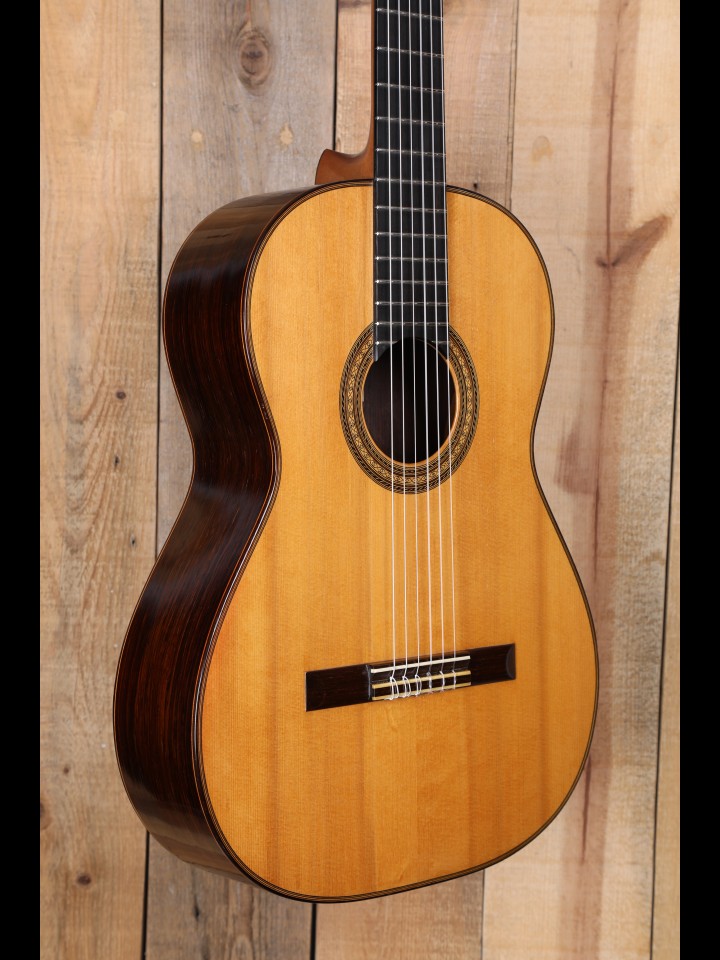


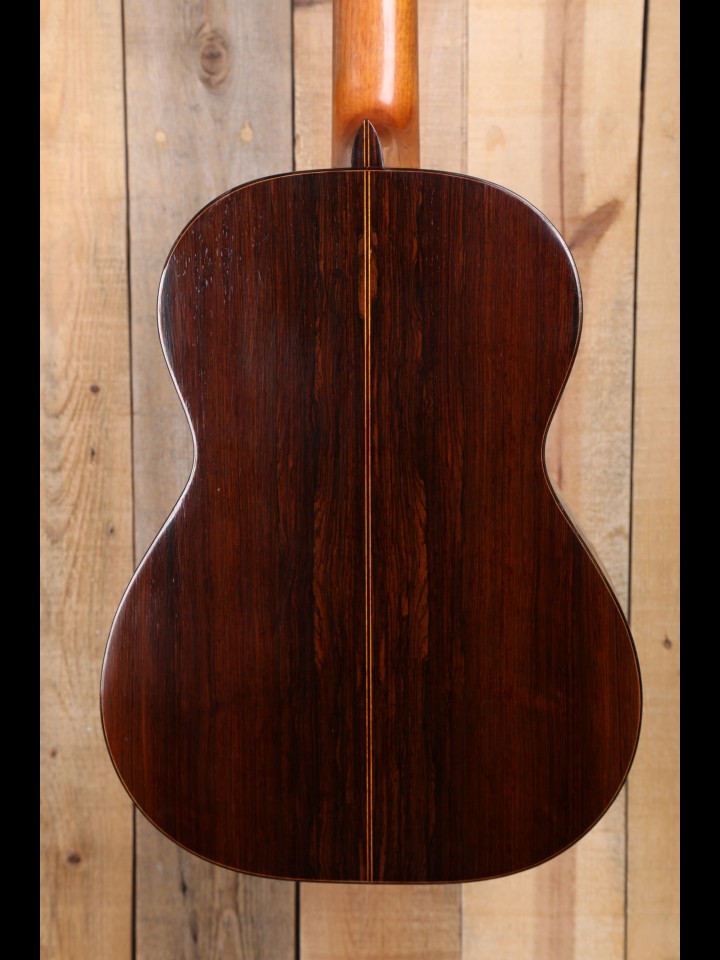
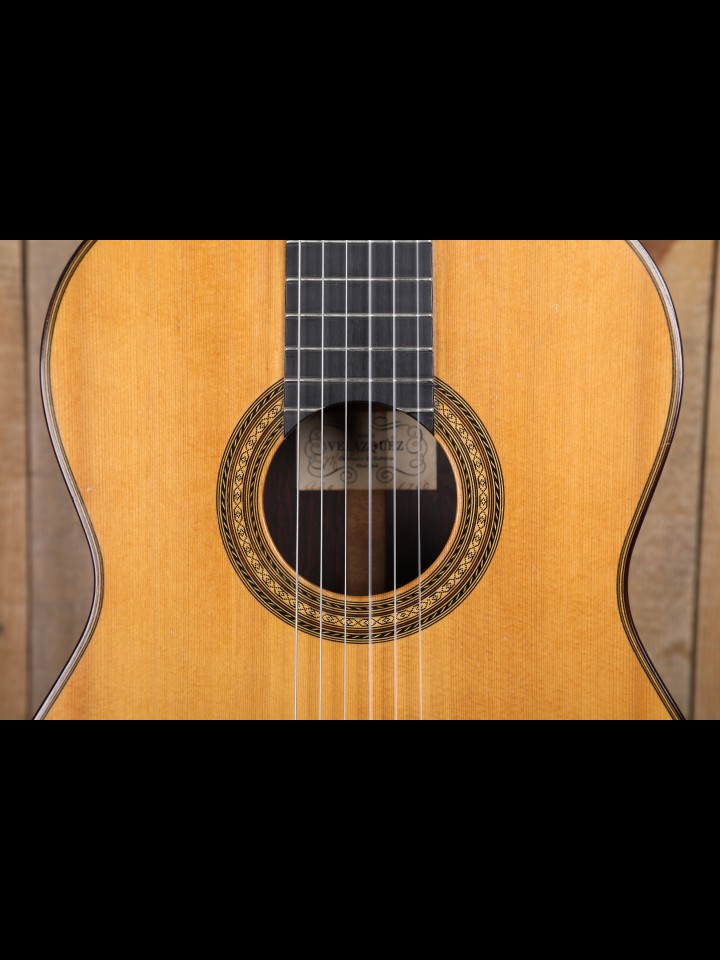


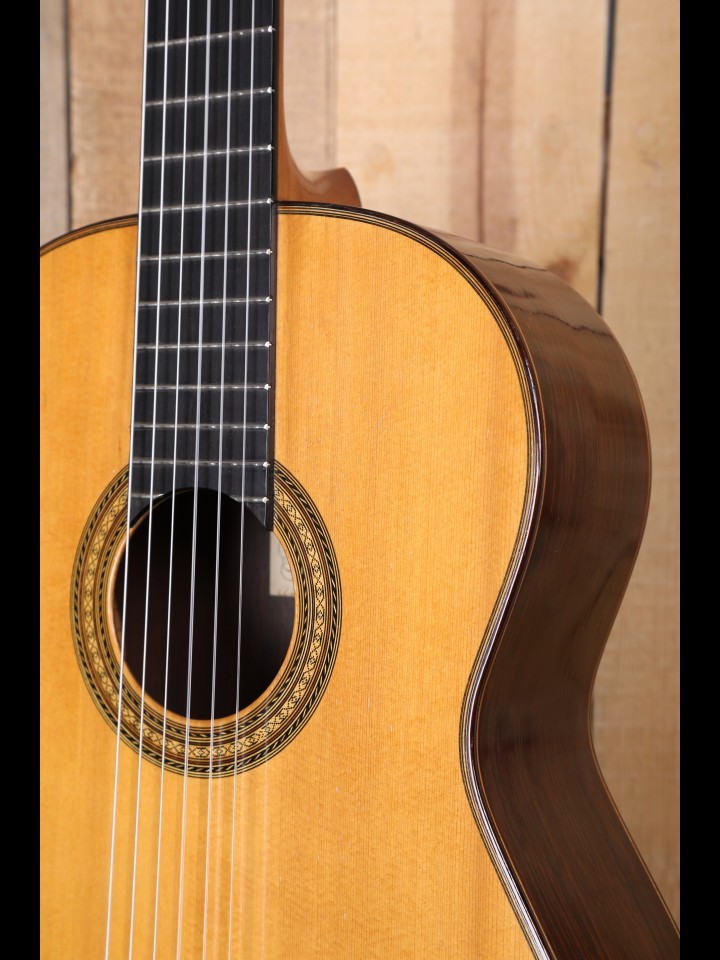

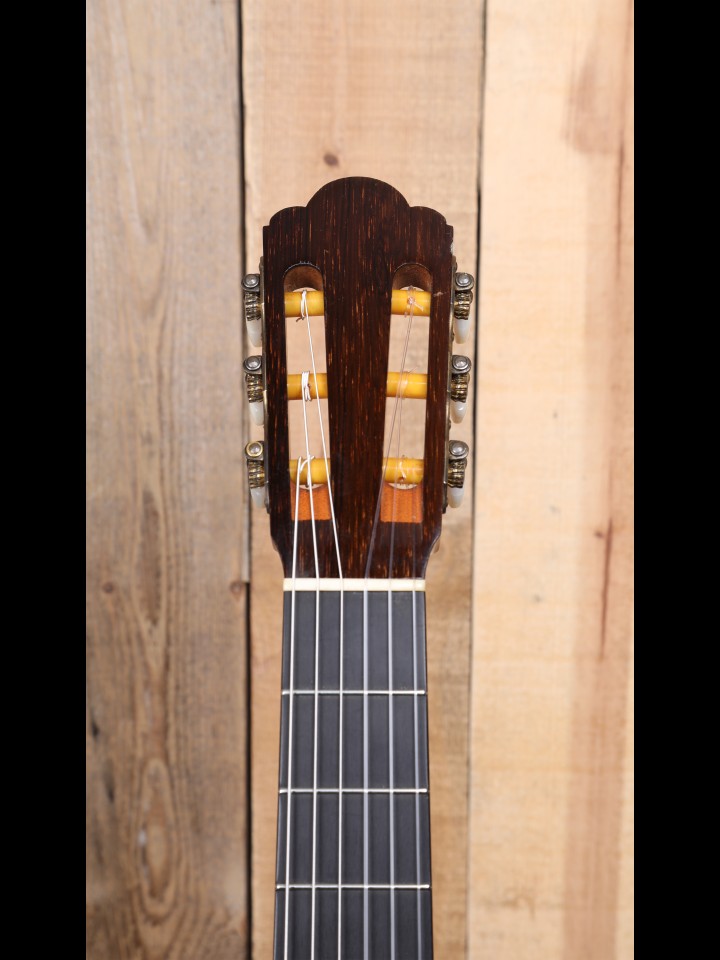


1960 Manuel Velazquez Spruce Top
In the world of classical guitar, the name Manuel Velazquez carries tremendous weight, as Velazquez is widely regarded as one of the greatest guitar builders of the 20th century, and he is most certainly one of the most highly regarded American builders in history. Born in Puerto Rico in 1917, Manuel Velazquez demonstrated an early interest in guitar making, purportedly crafting his first guitar at age 11 from salvaged wooden crates. At 14, his trajectory began to mirror that of many notable guitar makers (like C.F. Martin, for example) when he began training as a cabinet maker. Soon thereafter, he had the rare opportunity to attend a concert given by Andrés Segovia, where he was floored by the sound of Segovia’s legendary 1937 Hermann Hauser. Not surprisingly, the voice of that guitar (and Hauser voicing in general), in addition to that of both Antonio de Torres and Santos Hernandez, would ultimately serve as the foundation of Velazquez’s approach to building guitars.
At the outset of World War II in 1940, Velazquez’s cabinet making trade took him to New York, where he would later establish his first shop in 1948. His instruments and his abilities as a repairman quickly garnered the attention of the local classical guitar community, whose members began to promote him as a builder. As a result, one of Manuel’s guitars famously made its way into the hands of Andrés Segovia at a small gathering during one of his visits to New York. In this intimate salon gathering, Segovia was auditioning a selection of guitars and singled out one made by Velazquez (who was present) as the only one that rivaled his Hauser. Segovia evidently asked to meet the builder and, upon doing so, promptly informed Manuel that he was “too young to be a master builder.” Needless to say, this endorsement propelled Velazquez’s reputation and career with unrivaled efficiency, and the demand for his guitars surged!
Made in 1960, and marked as number 20, this particular example of Manuel Velazquez’s craft is an exciting insight into his earlier work. In many respects, this guitar affirms a trend that we have observed with respect to the works of other great builders—even their earliest (in some cases, first) efforts are a display of not only tremendous skill and meticulous craft but also keen voicing instincts that culminate in a surprisingly refined, top tier instrument. Within a set of 100 (or maybe 1000) woodworkers capable of producing an elegantly and properly constructed guitar in their initial efforts, perhaps only one will have the ability at the outset to also produce a guitar with a truly captivating voice that they can then reproduce in subsequent builds.
Featuring a classic pairing of European spruce and Brazilian rosewood, number 20 is a very special guitar indeed, possessed of a firm and colorful tone. As one would expect from a well-voiced spruce top, the notes are clearly-defined and strongly-sustained, particularly in the treble—no doubt this guitar would have passed Segovia’s high E string test! (For context, Segovia’s desire to elevate the guitar to a respected instrument, capable of orchestral application, was such that he fervently sought power in the high E, to the point that he was known to replace the E string with another B to increase projection. Subsequently, he was reputed to immediately concentrate on the sustain and tone of the high E string whenever auditioning any hopeful guitar, and he would quickly dismiss any guitar that didn’t impress him in this respect.) Meanwhile, the Brazilian rosewood back and sides contribute a reflective richness for which Brazilian rosewood is so highly prized.
Yet, this guitar is truly distinguished by the fact that its richness and color presents in a manner that not excessively ornamented or sugary. Rather, the player is met by an unassuming and uncommonly balanced voice in which every note sings out clearly from a place of earnest substance. In this respect, this Velazquez brims with the musical potential of a well trained choral ensemble, where every singer is actively listening to and matching one another, resulting in a rounded concord of tone. Indeed, even a dissonant interval becomes sonically interesting rather than harsh, due to the innately pleasing substance of the notes. In particular, the bass has a weight and a firm, even, and defined quality that remains uniform in each register. Meanwhile, the other voices in what would be considered the treble range (i.e., the soprano and alto registers) seem to sit naturally on the bass and are infused by its vowel quality, which they then carry—this is the essence of a beautifully blended timbre.
For the player, this uniformity in timbre creates a balance over the whole guitar that is quite exciting and satisfying, as one does not have to play to the strengths of the guitar or work to emphasize a particular register. In short, balance in the right hand attack is rewarded with balanced response, and the guitar simply delivers the notes you want to hear without any fuss. This uncommonly balanced timbre ultimately translates to a very alluring intimacy, where subtleties can shine; yet, this rare degree of vocal agreement remains consistent even when the instrument is played aggressively. Thus, in light of its unassuming yet pure and substantive vocal qualities, this Velazquez is a truly timeless instrument, and clearly the product of mastery. Despite its advancing years, its exceptional beauty endures, and it remains competitive with the finest guitars available to this day. (History referenced from GFA web archives)
Condition
For its age, this Velazquez has been remarkably well-preserved. From a cosmetic standpoint, we note only minor play wear in the form of various minor shallow scuffs and indentations, primarily seen on the top. Otherwise, there are no significant structural issues or repairs to note. At present, the action measures approximately at 4 mm on the bass sides and 3mm on the treble side with minimal saddle exposure (approximately 1.5 mm on the bass side and .5 mm on the treble side). Upon its arrival, we did observe that two of the gear set screws for the Landstorfer tuners were missing. We have since sourced proper stainless steel replacements and replaced all six with the new screws, which were torched to create a darker, aged look. The original screws and an additional set of replacements are included. – EXCELLENT+ Condition
- Classical Body
- European Spruce Top
- 7-Fan Top Bracing with 2-Tonebars
- Segmented Spruce Top Lining and Braces
- Mahogany Back Lining (Kerfed) and Braces
- Brazilian Rosewood Back and Sides
- Brazilian Rosewood Body Binding
- 6-Ply Top Purfling
- Single-Ply Back and Side Purfling
- 3-Ply Backstrip and Endpiece
- Brazilian Rosewood Heelcap
- Rope and Diamond Motif Rosette
- Oil-Based Varnish Body Finish
- Spanish Cedar Neck
- Ebony Fingerboard
- 19 Frets
- Brazilian Rosewood Headstock Veneer
- Oil-Based Varnish Neck Finish Brazilian
- Rosewood Bridge
- Landstorfer Engraved Brass Tuners with Shell Buttons
- Bone Nut and Saddle
- 652 mm Scale
- 51 mm Nut Width
- 8.75 mm String Spacing
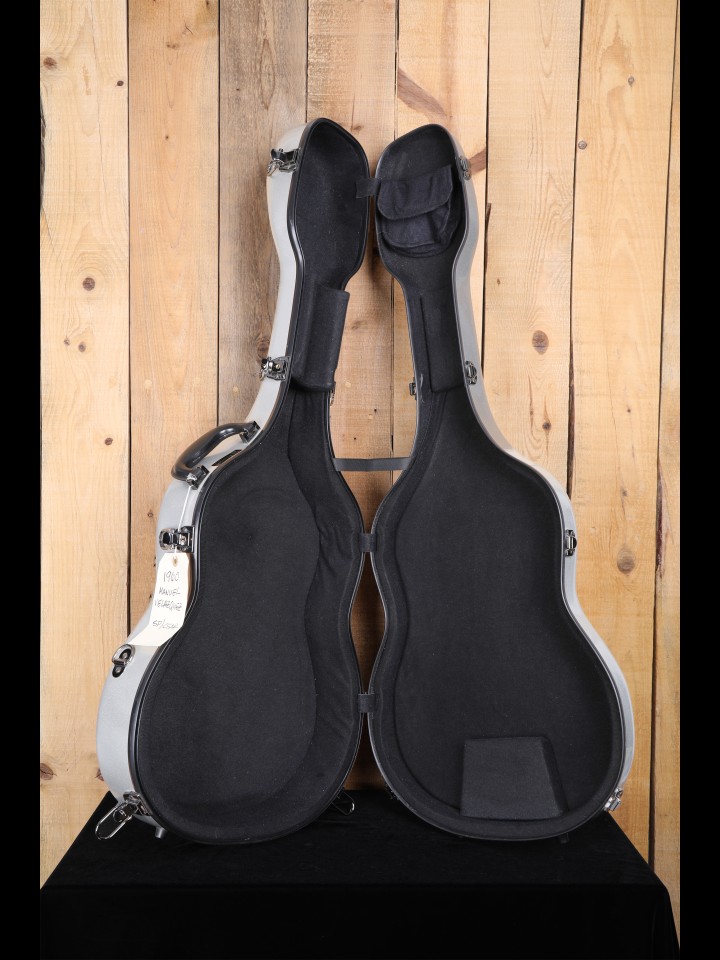
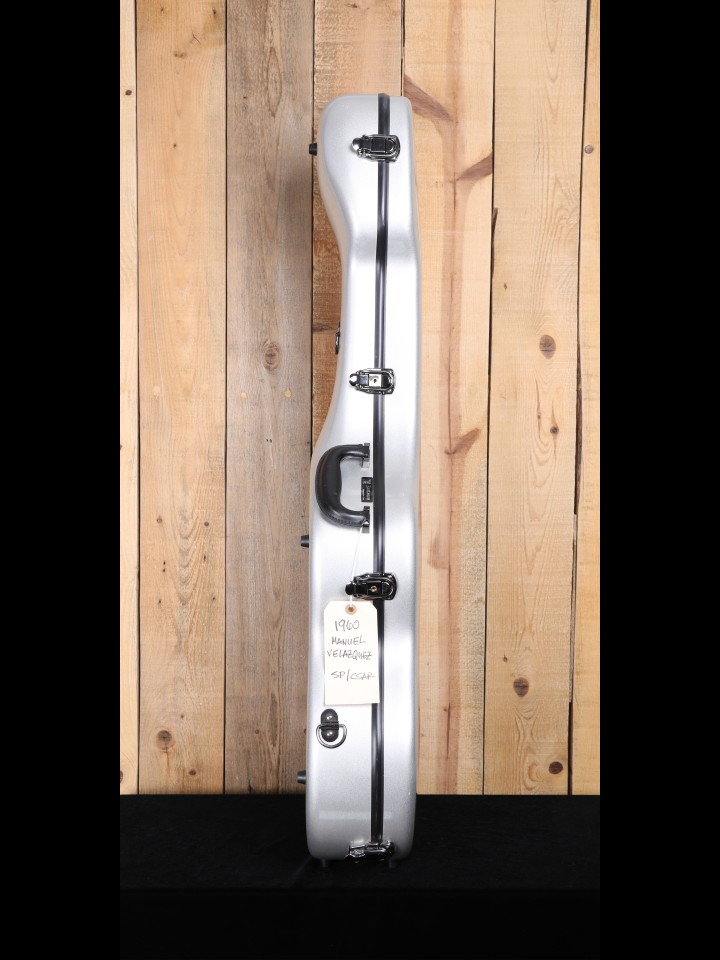
- Fiberglass Hard Case
| Brand | VELAZQUEZ |
| Model | VELAZQUEZ 1960 |
| Serial Number(s) | 20 |